Content
The most accurate way to measure a child's underwear size is to use a soft measuring tape to record two key measurements: the waist circumference and the hip circumference. Compare these numbers to the brand's size chart, and always size up when your child falls between two sizes. Most children's underwear in the US is sold by age range (such as 2T, 4T, or sizes 4-16), but relying on age alone leads to poor fit. Actual body measurements are the only reliable guide.
Before taking any measurements, gather the right tools and prepare your child. Accuracy depends on technique as much as equipment.
Have your child stand relaxed with feet together. Avoid measuring over thick clothing, as even a single layer of denim can add over an inch to the reading.
The waist measurement is the most important number for underwear sizing. Here is how to do it correctly:
For example, a child with a 22-inch (56 cm) waist typically falls into a size 6 or 6X in most major US brands, though this can shift by one size depending on the manufacturer.
Hip measurement is especially important for girls' underwear and for brief or boyshort styles that sit across the fullest part of the hips.
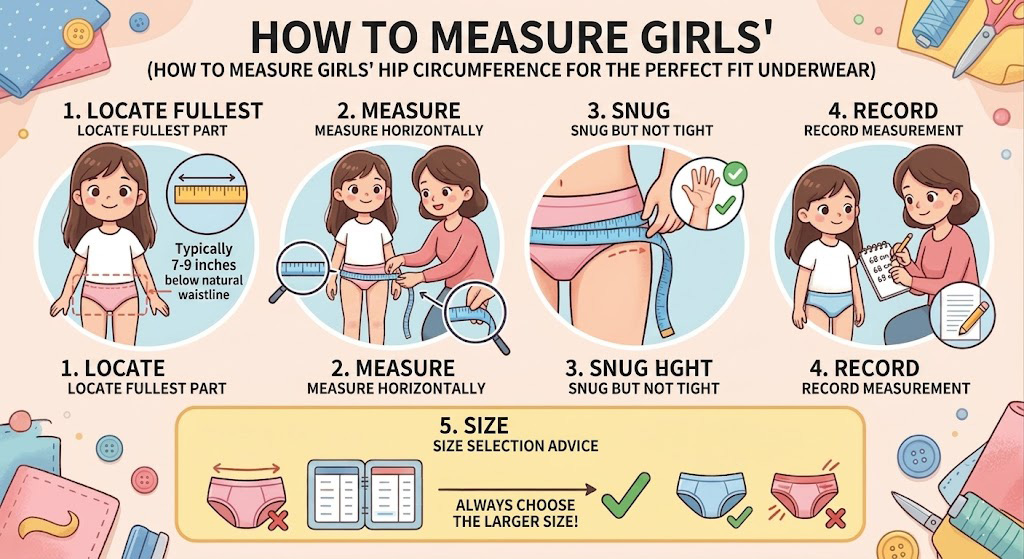
If the waist and hip measurements point to different sizes on a size chart, always choose the larger of the two sizes. Underwear that fits through the hips but is tight at the waist will be uncomfortable and may leave marks on the skin.
The table below provides a general reference for US children's underwear sizes. Always verify with the specific brand you are purchasing from, as sizing can vary by 1 to 2 inches between manufacturers.
| Size Label | Approximate Age | Waist (inches) | Waist (cm) | Hip (inches) |
| 2T | 2 years | 19 - 20 | 48 - 51 | 20 - 21 |
| 3T | 3 years | 20 - 21 | 51 - 53 | 21 - 22 |
| 4 / 4T | 4 years | 21 - 22 | 53 - 56 | 22 - 23 |
| 5 | 5 years | 21.5 - 22.5 | 55 - 57 | 23 - 24 |
| 6 | 6 years | 22 - 23 | 56 - 58 | 24 - 25 |
| 7 / 8 | 7 - 8 years | 23 - 24 | 58 - 61 | 25 - 27 |
| 10 / 12 | 9 - 11 years | 25 - 27 | 64 - 69 | 28 - 30 |
| 14 / 16 | 12 - 14 years | 27 - 29 | 69 - 74 | 31 - 34 |
Age labels on children's clothing are estimates based on average growth data, but children grow at very different rates. Research from pediatric growth studies shows that by age 6, the range of healthy waist measurements among children of the same age can span 4 inches or more. A child who is tall for their age may need a size 8 at age 6, while a smaller child of the same age may wear a size 4 comfortably.
Underwear that is too small causes discomfort, restricted movement, and can leave painful elastic marks. Underwear that is too large bunches under clothing, slides down, and may cause chafing. Neither outcome is acceptable for everyday wear, which is why measured sizing is always preferable to age-based guessing.
While the measuring technique is the same, the fit priorities differ between boys' and girls' underwear styles.
For briefs and boxer briefs, the waist measurement is the primary sizing factor. Boys tend to have straighter proportions, so the waist number alone is usually sufficient. A boy with a 24-inch waist will typically wear a size 7/8 in most major brands such as Hanes or Fruit of the Loom.
Girls' underwear, particularly styles like bikinis, boyshorts, or hipsters, requires both waist and hip measurements. Girls often develop a more pronounced hip-to-waist difference earlier than boys, especially after age 8. When the two measurements suggest different sizes, always go with the hip measurement as the deciding factor for these styles.
Children go through growth spurts that can add 2 to 3 inches to their waist and hip measurements within a single year. As a general rule:
A practical tip: keep a small notebook or use a notes app to log your child's measurements with dates. This makes it easy to track growth patterns and anticipate when a new size will be needed before the current one becomes uncomfortable.
Even with accurate measurements, a few additional factors affect how well underwear fits in practice.

Copyright © Nantong Tianhong Textile Technology Co., Ltd. All Rights Reserved.
 Room 806, Building D, Jingyang Plaza, Chongchuan District, Nantong City, Jiangsu Province,china


 English
 Español
 русский
 عربى
عربى